
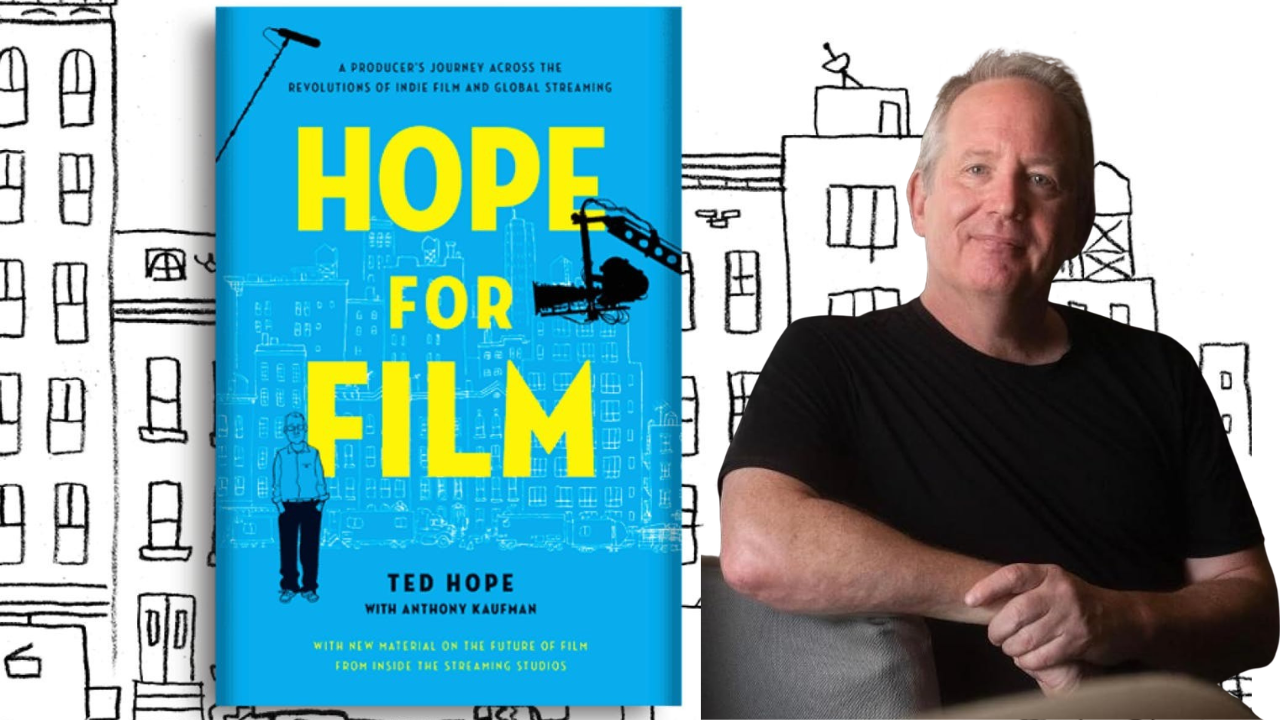
The Cinematography Podcast Episode 352: Ted Hope
Producer Ted Hope has worked in the film business for over 40 years, producing dozens of features with several Academy Awards nominations and wins. After leaving Amazon Studios in 2020, Hope went back to his roots as an independent producer and began writing his Substack blog, Hope For Film. He argues that the independent film ecosystem as we know it has reached its final days. However, far from being a tragedy, Ted definitely has hope for film. He sees what’s happening in the industry today as a necessary seismic shift. Hope has a vision for a more “punk rock” future of cinema, with a decentralized, artist-owned future that prioritizes “freak flags” and human empathy over corporate consolidation.
Hope recalls a time in his 30s when a producer had roughly 250 different distributors to choose from. Today, that number has withered down to about four. “The American entertainment industry was such a beautiful thing for its wide range of subjects and approaches, its global reach,” he says. “The leaders really just made one dumbass decision after another and got swamped. So we lost the full American cinema ecosystem for grownups.”
The culprits, of course, are media consolidation and the rise of streaming services. With streaming, most films become less of an event, with months of marketing and anticipation. Instead, many are simply dropped onto a homepage, often disappearing into the digital abyss within 48 hours.
Hope believes we need to stop trying to fix the system and start building a new one. He advocates for cinema with a smaller footprint with budgets from $10,000 to $200,000. By lowering the cost, filmmakers gain the freedom to follow their creative desires, without the crushing pressure of delivering a corporate-friendly return on investment. As Hope puts it, “I’d rather see your freak flag, you know, shining in the sun, warts and all, than pretend to be something you could never possibly be.”
Despite the technological shifts, Hope remains a firm believer in the human element of cinema. Film’s best defense against AI is embracing cinema that mimics life and human complexity, with scripts that contain ambiguity rather than payoffs. “Cinema is the most life-like art form. I like the ambiguity. I like the mystery,” he says. “I feel like AI is not really a threat to cinema because it’s about empathy. It’s about you sitting in a dark room and having an empathetic connection with what’s playing out on the screen in front of you. And that is not something that AI does well. That is what humans do really well.”
So, how do we build a new system? Hope has some ideas.
- Create non-profit, decentralized distribution sales and marketing systems
- Use direct-to-audience pipelines with tools like community outreach and social media
- Find a balance for independent filmmakers, where directors alternate between large-scale projects and intimate, experimental movies.
He points to people like Taylor Swift and YouTuber Markiplier as examples of artists independently forging their own way forward. They own their IP, they know their audience, and they aren’t waiting for a distributor to cough up money for their projects.
The demise of the old system will allow filmmakers to return to a sense of joy and play, Hope feels. The tools are finally in the hands of the creators. “Stop trying to deliver the commercial film without the resources to do it,” Hope challenges. “Keep reaching further than your boundaries. That’s where my hope for film lies.”
Find Ted Hope
We have an exclusive discount offer to subscribe to Ted Hope’s substack, Hope For Film!
Get 50% a 1 year subscription at https://tedhope.substack.com/cinepod.
This offer expires on April 20 (4/20) at 4:20 PM PT.
Close focus: The WGA and the The Alliance of Motion Picture and Television Producers (AMPTP) have struck a new four year deal.
Ben’s short end: I Get Knocked Down, a documentary on Tubi about Chumbawamba band member Dunstan Bruce.
Illya’s short end: NAB will be from April 18-22 in Las Vegas. To get FREE REGISTRATION, register at NAB and use code NS3988. Stop by the League of Filmmakers booth to see Illya showing off the Betty Lights reflector!
Sponsored by Hot Rod Cameras
Check out the new Betty Luminous Reflector at Hot Rod Cameras! The Betty Luminous is a full-spectrum light reflector designed to beautifully flatter human skin. Its fresnel-like directionality provides focused illumination while its gentle Gaussian falloff ensures a soft, natural look.
Sponsored by Greentree Creative: If you enjoy The Cinematography Podcast and you’re interested in growing or starting your own podcast, contact Alana Kode at Greentree Creative. Greentree Creative can help you with all of your digital marketing needs including podcast launch and creation, advertising, social media management and content creation.
SHOW RUNDOWN:
03:07 Close Focus
06:44-01:13:14 Ted Hope interview
01:14:04 Short ends
01:25:42 Wrap up/Credits
LIKE AND FOLLOW US, send fan mail or suggestions! Rate, review and subscribe on Apple Podcasts!
Email: editor@camnoir.com
Facebook:@cinepod
Instagram: @thecinepod
Threads: @thecinepod
Blue Sky: @thecinepod.bsky.social
Podcast Credits:
Producer: Alana Kode
All web and social media content written by Alana Kode
Host and editor in Chief: Illya Friedman
Instagram: @illyafriedman @hotrodcameras
Host: Ben Rock
Blue Sky: @benrock.com
Instagram: @bejamin_rock
Composer: Kays Al-Atrakchi
Check out Kays’ new YouTube Channel, Kays Labs, where he repairs old synthesizers.
Editor: Alana Kode
Subscribe to the Podcast on Apple Podcasts or click on the link below to listen here
Podcast: Play in new window | Download (Duration: 1:11:12 — 0.2KB)
Subscribe: RSS
