
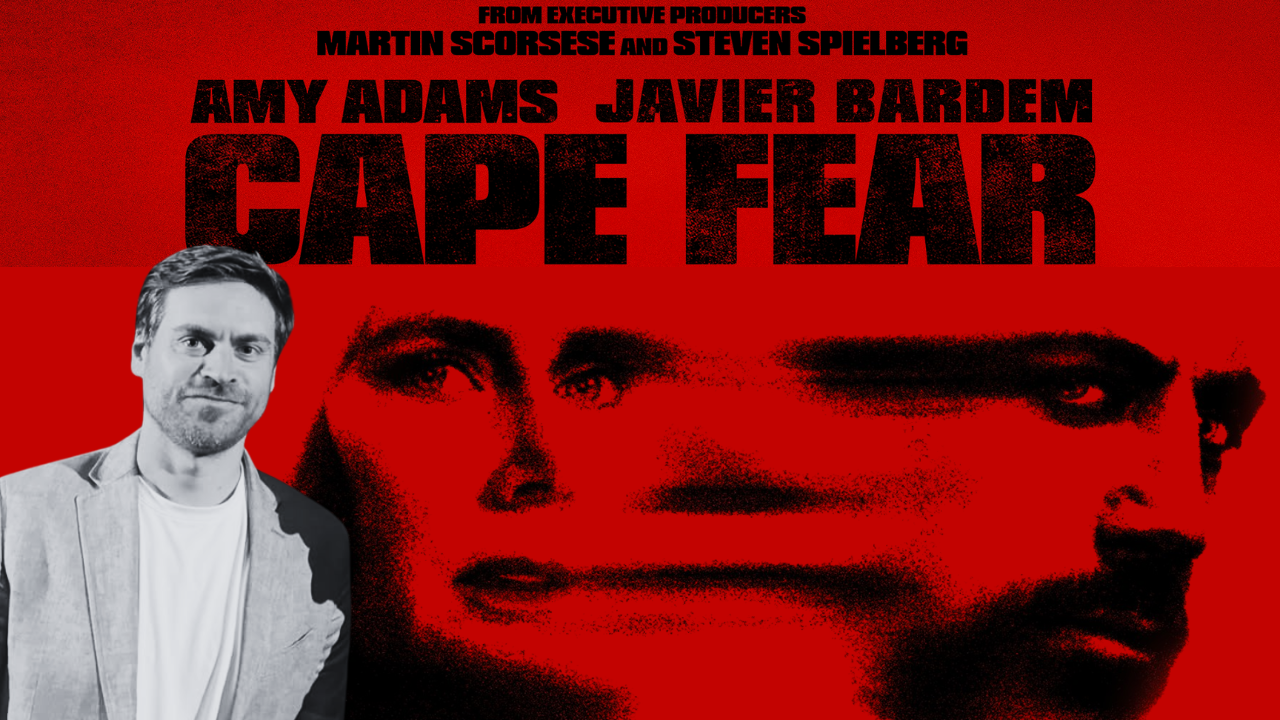
The Cinematography Podcast Episode 366: Eben Bolter, ASC, BSC
When Eben Bolter, ASC, BSC signed on to shoot Apple TV’s new adaptation of Cape Fear, he inherited a legacy that includes both the 1962 original and Martin Scorsese’s 1991 remake. Rather than avoid the comparison, Bolter embraced it, and he’s created a visually distinctive look for the series. “I always thought the ’91 movie was weird in the best possible way,” Bolter says. “It’s a really great example of expressionism. It’s the opposite of documentary filmmaking. It’s not verité. It’s not found. It’s not naturalistic. It’s big and theatrical.”
That theatricality became the show’s north star. Bolter and co-cinematographer Celiana Cárdenas built their visual language around noir lighting, extreme close-ups, and a psychological approach to color, embracing wet, saturated hues. “How can I use hard lighting, shadows, shapes to make this thing feel more alive and to be less naturalistic?” Bolter explains. He wanted it to be a deliberate departure from the documentary-style naturalism he brought to HBO’s The Last of Us. Both he and Cárdenas built a kind of “visual manifesto” during prep and updated it with images throughout the season to keep a unified aesthetic across different directors.
The Savannah, Georgia location became inseparable from the show’s look. Bolter recalls the humidity hitting him the moment he stepped off the plane, and it shaped everything from the production design to lens choice. Shooting on Atlas Mercury anamorphics, he wanted a specific quality in the image. “The way anamorphic lenses squeeze and de-squeeze an image, you get the kind of oval bokeh which is just that little bit more watery,” he says. “If you think of Blade Runner, that kind of non-spherical bokeh gives a watercolor feel.” Combined with wet streets, condensation, and gloss-painted interiors, the visual world of Cape Fear becomes as damp and oppressive as its Southern Gothic setting.
Some of the show’s most striking moments came from simple, practical solutions rather than visual effects. To create in-camera lens flares on demand, Bolter’s team rigged LED pixel tape inside the matte box. “We wanted the ability to flare the lens without having to catch a practical light. So we could flare the lens by pressing buttons,” he says.
That instinct toward practical, hands-on craft runs deep for Bolter, who started out shooting DSLRs and has spent his career chasing the older techniques he feels the industry has quietly forgotten. “I’ve always wanted to be a bit more old-fashioned in my filmmaking. We’ve sort of forgotten more about filmmaking than we’ve learned,” he says. He feels that in an age of AI-generated imagery, audiences are hungry for filmmaking that feels physical and unpredictable. “What people want is physical, tactile, risky, bold filmmaking that they haven’t seen. It’s not derivative. It’s not an algorithm. It’s not everything else. I think these risks get rewarded reasonably often.”
With Scorsese and Spielberg among the show’s executive producers, Bolter describes a rare creative environment where boldness was rewarded rather than tempered. “I think they understood the tone of the show. They understood what we were going for and they empowered everyone. If Spielberg or Scorsese had said, oh, you know, calm down, this is too crazy. Obviously, that would have been disappointing, because that’s not what we were doing. And that never happened. It was always more, more, more.”
Find Eben Bolter: Instagram: @ebenbolter
Cape Fear is streaming on AppleTV

CAMERA: ARRI Alexa 35, shot open gate RAW
LENSES: Atlas Mercury 1.5 anamorphic, Technovision 1.5 anamorphic
Close focus: The Netflix deal with YouTube variety show, Good Mythical Morning.
Ben’s short end: Underware, free opensource 3D printer software for cable management solutions.
The trailer for the upcoming film Digger directed by Alejandro González Iñárritu.
Illya’s short end: There will be an announcement by Sony about a new camera system? or lens? or something cool, coming next week.
Sponsored by Hot Rod Cameras
Check out the new Betty Luminous Reflector at Hot Rod Cameras! The Betty Luminous is a full-spectrum light reflector designed to beautifully flatter human skin. Its fresnel-like directionality provides focused illumination while its gentle Gaussian falloff ensures a soft, natural look.
Sponsored by Greentree Creative: If you enjoy The Cinematography Podcast and you’re interested in growing or starting your own podcast, contact Alana Kode at Greentree Creative. Greentree Creative can help you with all of your digital marketing needs including podcast launch and creation, advertising, social media management and content creation.
SHOW RUNDOWN:
01:59 Close Focus
14:14-58:02 Eben Bolter Interview
59:16 Short Ends
01:08:21 Wrap up/Credits
LIKE AND FOLLOW US, send fan mail or suggestions! Rate, review and subscribe on Apple Podcasts!
Email: editor@camnoir.com
Facebook:@cinepod
Instagram: @thecinepod
Threads: @thecinepod
Blue Sky: @thecinepod.bsky.social
Podcast Credits:
Producer: Alana Kode
All web and social media content written by Alana Kode
Host and editor in Chief: Illya Friedman
Instagram: @illyafriedman @hotrodcameras
Host: Ben Rock
Blue Sky: @benrock.com
Instagram: @bejamin_rock
Composer: Kays Al-Atrakchi
Check out Kays’ new YouTube Channel, Kays Labs, where he repairs old synthesizers.
Editor: Alana Kode
Subscribe to the Podcast on Apple Podcasts or click on the link below to listen here
Podcast: Play in new window | Download (Duration: 1:11:12 — 0.2KB)
Subscribe: RSS
