
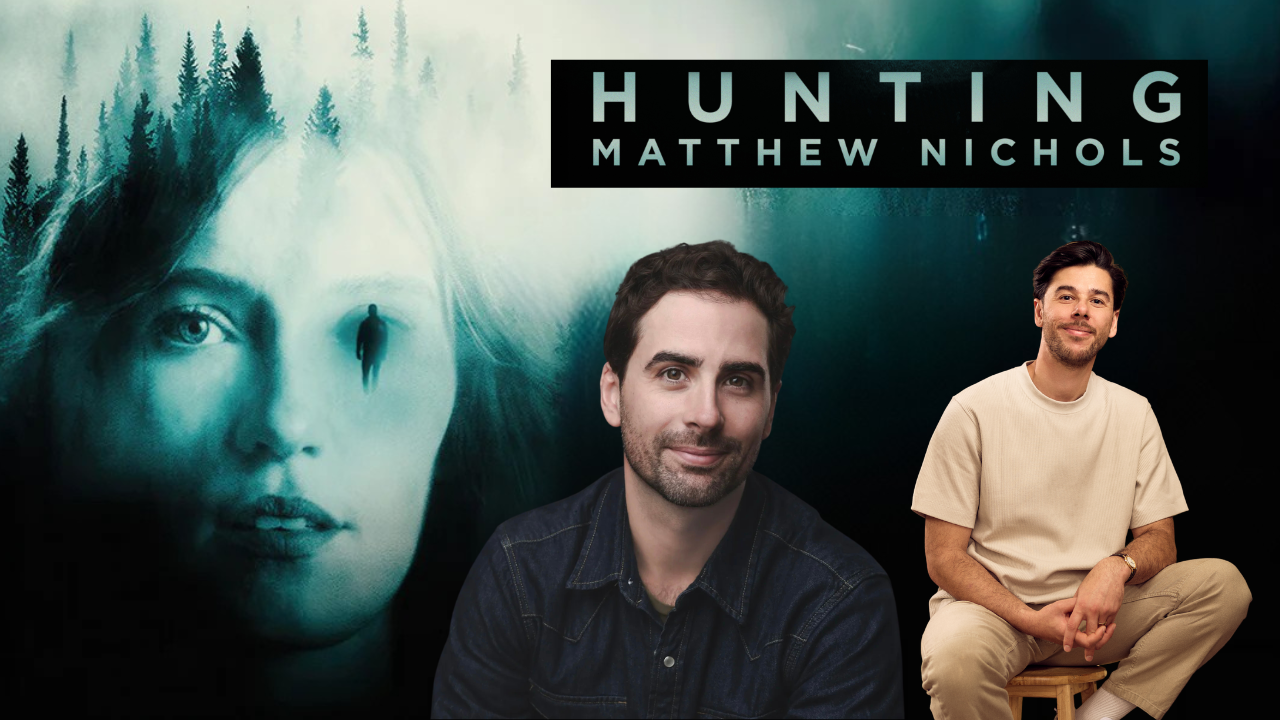
Hunting Matthew Nichols is an indie horror film that’s shot as a mockumentary/found-footage movie about a documentary filmmaker investigating her brother’s disappearance 20 years earlier on Vancouver Island, Canada. The “found footage” genre done poorly usually involves shaky cams and forced exposition. But Hunting Matthew Nichols treats the camera not just as a recording device, but as an actual character.
Writer/producer Sean Harris Oliver and cinematographer Justin Sebastian paid such close attention to detail that even the cameras selected for the film reflect what the characters inside the story would realistically have. Rather than using a high-end digital camera, Sebastian opted for the Sony FX9, purposefully using autofocus as the filmmaker characters would. “We realized that we wanted to just lean into the mistakes of the AI autofocus and if it slipped, it’s like, that’s how it would have been,” says Sebastian. “And then you see the quick readjustments: ‘oh, it slipped, get shots real quick’ kind of thing. We really leaned into that roughness to just to build into that authenticity of the documentary style.”
That authenticity included the crew and lighting choices Sebastian made. He chose to use a very small film crew of just three people. Most of the film was shot with practical lighting or natural light. To achieve the look of the early 2000s for the film’s archival footage, the team hunted down actual hardware, including an original Panasonic Palmcorder and a late-90s JVC GY-HC500 ENG camera. The camera’s natural scan lines gave the newscast footage a look no digital grade could have replicated.
The visual language of the script was a carefully choreographed descent into chaos. To maintain the documentary style, the camera operators in the film were often the actors themselves. Sebastian handled the sit-down interview shots and archival footage, while actor Ryan McDonald, who plays the documentary filmmaker within the story, did most of the present-day shots. Director and lead actor Markian Tarasiuk shot the wildest material, often with the camera in his lap to simulate an untrained eye. In the film’s final act, Tarasiuk is simply using the camera as a flashlight in the forest, running with dirt smeared on the lens.
The script was one of the most complex Sean Oliver had ever written, with specific cuts to historical footage, home video, animated sequences, newscast recreations, and reenactments, all interwoven with the present-day documentary footage. “Those specific indications of who’s shooting in the script actually started to inform the story,” he says. “It’s like, oh, this is a handheld POV shot — oh, this is a sitting cinematic shot. There’s a layer of intricacy that I’m glad you’re seeing in the film.”
Shooting a film in 12 days with a small crew is a feat of endurance. Getting an indie feature onto 900 screens without a major studio is a feat of pure willpower. Oliver was adamant about avoiding a straight-to-streaming deal. The transition to the big screen involved several invisible costs that many indies overlook—DCP delivery, MPAA ratings, and even paying for the trailer to play in theaters. The team ran their own ad campaigns on social media, created all their own marketing materials, and built an interactive game into the film’s website to generate interest.
Oliver’s advice for independent filmmakers: build distribution, delivery, and marketing into the budget from the very beginning. Don’t assume a distributor will customize a campaign for a lower-budget film- in most cases, they won’t. But he thinks there’s a path to the big screen for the boldest indie voices. “I think that filmmakers can do this kind of work and figure it out,” Oliver says. “We’re already creative people. It’s just going a little bit beyond the story and asking, how are we going to put this trailer out there? What are the different fun marketing tactics we’re going to use?”
Find where to watch Hunting Matthew Nichols in theaters and play the interactive game on the website.
Find Sean Harris-Oliver: Instagram: @SeanHarrisOliver
Find Justin Sebastian: Instagram: @JustinSebastianDP
Listen to our episode with producer Ted Hope, who discusses similar approaches indie filmmakers can take to understand and control the entire filmmaking process from budget to shoot to distribution.

CAMERAS: Sony PXW-FX9, Sony FX3, Panasonic Palmcorder, JVC GY-HC500 ENG camera
LENSES: Sigma Art-photography version for autofocus, Zeiss compact zooms (formal interviews)
Close focus: The Warner Bros/Paramount merger has been approved by shareholders. Meanwhile, Hollywood has circulated a petition, now with 4,000 names, in an effort to stop the merger.
Kays’ short end: Corridor Digital has released new software that fixes greenscreen problems very well.
Ben’s short end: Adobe Premiere has completely overhauled its color grading system. You can play around with the new “color mode” in its beta version.
Sponsored by Hot Rod Cameras
Check out the new Betty Luminous Reflector at Hot Rod Cameras! The Betty Luminous is a full-spectrum light reflector designed to beautifully flatter human skin. Its fresnel-like directionality provides focused illumination while its gentle Gaussian falloff ensures a soft, natural look.
Sponsored by Greentree Creative: If you enjoy The Cinematography Podcast and you’re interested in growing or starting your own podcast, contact Alana Kode at Greentree Creative. Greentree Creative can help you with all of your digital marketing needs including podcast launch and creation, advertising, social media management and content creation.
SHOW RUNDOWN:
02:45 Close Focus
13:04-01:02:59 Sean Harris Oliver and Justin Sebastian interview
01:03:19 Short ends
01:12:42 Wrap up/Credits
LIKE AND FOLLOW US, send fan mail or suggestions! Rate, review and subscribe on Apple Podcasts!
Email: editor@camnoir.com
Facebook:@cinepod
Instagram: @thecinepod
Threads: @thecinepod
Blue Sky: @thecinepod.bsky.social
Podcast Credits:
Producer: Alana Kode
All web and social media content written by Alana Kode
Host and editor in Chief: Illya Friedman
Instagram: @illyafriedman @hotrodcameras
Host: Ben Rock
Blue Sky: @benrock.com
Instagram: @bejamin_rock
Composer: Kays Al-Atrakchi
Check out Kays’ new YouTube Channel, Kays Labs, where he repairs old synthesizers.
Editor: Alana Kode
Subscribe to the Podcast on Apple Podcasts or click on the link below to listen here
Podcast: Play in new window | Download (Duration: 1:11:12 — 0.2KB)
Subscribe: RSS
