
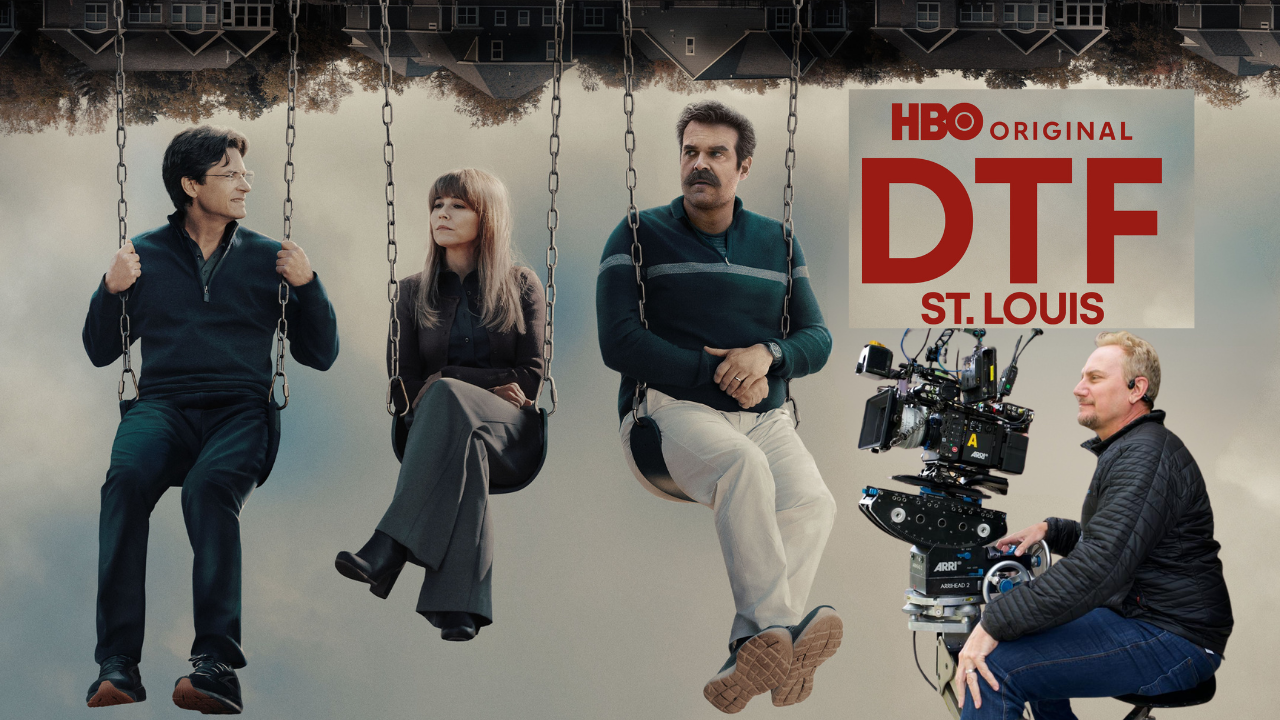
The Cinematography Podcast Episode 362: James Whitaker, ASC
When he was researching the look for DTF St. Louis, cinematographer James Whitaker, ASC found a striking image while scrolling Instagram. “I came across an image of Sharon Tate from 1968 sitting at a cafe in Paris,” Whitaker says. “It just had this beautiful quality to it. Really strong blacks. You could tell it was shot on slide film. It had sort of a warm skin tone.” The photograph, along with suburban street photography, became the visual inspiration for the entire series about male friendship, loneliness, and a murder mystery in the suburbs of St. Louis. The ordinariness of the suburbs became the canvas. “I love this idea that six or seven of the greatest street photographers in the world showed up in this suburb and would capture it from an observational point of view,” he says.
Whitaker and writer/director Steve Conrad have collaborated now across four projects spanning more than a decade, and that observational instinct runs deep in the looks they choose. DTF St. Louis is suffused with voyeurism, with characters peering through windows, reviewing grainy surveillance footage, watching each other from screened-in porches. It’s a visual philosophy that compounds the show’s central mystery, keeping the audience perpetually positioned as witnesses rather than participants.
The police station stands out as a brutalist interior built entirely on stage. It was an unusual look for a precinct. It started with a practical conversation between Whitaker and production designer Laura Fox about what to put outside the windows. When the standard solutions of green screens, trans lights, and LED walls felt uninteresting, Fox pivoted entirely, designing inward instead. The result is a space that Whitaker describes as feeling like “somewhere in Eastern Europe,” lit through towering slatted walls using a custom array of 63 Sumalux panels bound together to simulate hard, parallel sunlight from a single direction. “That approach allowed a parallel beam to come through these slatted windows, but it had a nice quality to it. A really nice soft quality.”
The show’s many intimate scenes in the hotel room between Jason Bateman and Linda Cardellini‘s characters required very little disruption to adjust lighting and camera. Whitaker approached his gaffer and key grip to rig a 20/24K T12 onto a modified technocrane head, allowing a hard sunlight source to be positioned from outside the window in real time, even while rolling. “Emotionally I was looking for lens flares during this time with the two of them together at various times,” Whitaker explained, describing how the rig let him chase that effect without ever breaking the moment. Paired with soft LED key lights and negative fill inside the room, the whole setup could be adjusted by a board operator outside the set — meaning the only thing that had to stay uninterrupted was the scene itself.
The framing philosophy for DTF St. Louis was discomfort by design. “If this feels normal, then the camera’s in the wrong space. That’s kind of what I was working for,” Whitaker says. Characters are pushed into corners, buried under headroom, observed through obstructions. The comedy, and there is plenty of it, is never telegraphed by the camera. “We really don’t play the humor ever,” comments Whitaker. “It’s much more important to us that we’re leaning into the mystery and the drama.”
At its core, DTF St. Louis is a show about loneliness. “Those juxtapositions are what allows us to become so emotionally vulnerable to what Steve is trying to say,” Whitaker says. “And often in this particular case, he’s talking about loneliness. And it’s devastating.” That a show can be funny, yet land this hard is a result of the complete trust between Conrad and Whitaker.
Find James Whitaker: Instagram: @jameswhitaker_dop
Hear our previous episode with James Whitaker on Good Luck, Have Fun, Don’t Die.

CAMERA: ARRI Alexa 65, ARRI Alexa 265, Bolex 16mm
LENSES: ARRI Prime DNA, rehoused Hasselblad, Minolta and Mamiya, Masterbuilt-rehoused 58mm Nikkor
Sponsored by Hot Rod Cameras
Check out the new Betty Luminous Reflector at Hot Rod Cameras! The Betty Luminous is a full-spectrum light reflector designed to beautifully flatter human skin. Its fresnel-like directionality provides focused illumination while its gentle Gaussian falloff ensures a soft, natural look.
Sponsored by Greentree Creative: If you enjoy The Cinematography Podcast and you’re interested in growing or starting your own podcast, contact Alana Kode at Greentree Creative. Greentree Creative can help you with all of your digital marketing needs including podcast launch and creation, advertising, social media management and content creation.
LIKE AND FOLLOW US, send fan mail or suggestions! Rate, review and subscribe on Apple Podcasts!
Email: editor@camnoir.com
Facebook:@cinepod
Instagram: @thecinepod
Threads: @thecinepod
Blue Sky: @thecinepod.bsky.social
Podcast Credits:
Producer: Alana Kode
All web and social media content written by Alana Kode
Host and editor in Chief: Illya Friedman
Instagram: @illyafriedman @hotrodcameras
Host: Ben Rock
Blue Sky: @benrock.com
Instagram: @bejamin_rock
Composer: Kays Al-Atrakchi
Check out Kays’ new YouTube Channel, Kays Labs, where he repairs old synthesizers.
Editor: Alana Kode
Subscribe to the Podcast on Apple Podcasts or click on the link below to listen here
Podcast: Play in new window | Download (Duration: 1:11:12 — 0.2KB)
Subscribe: RSS
