
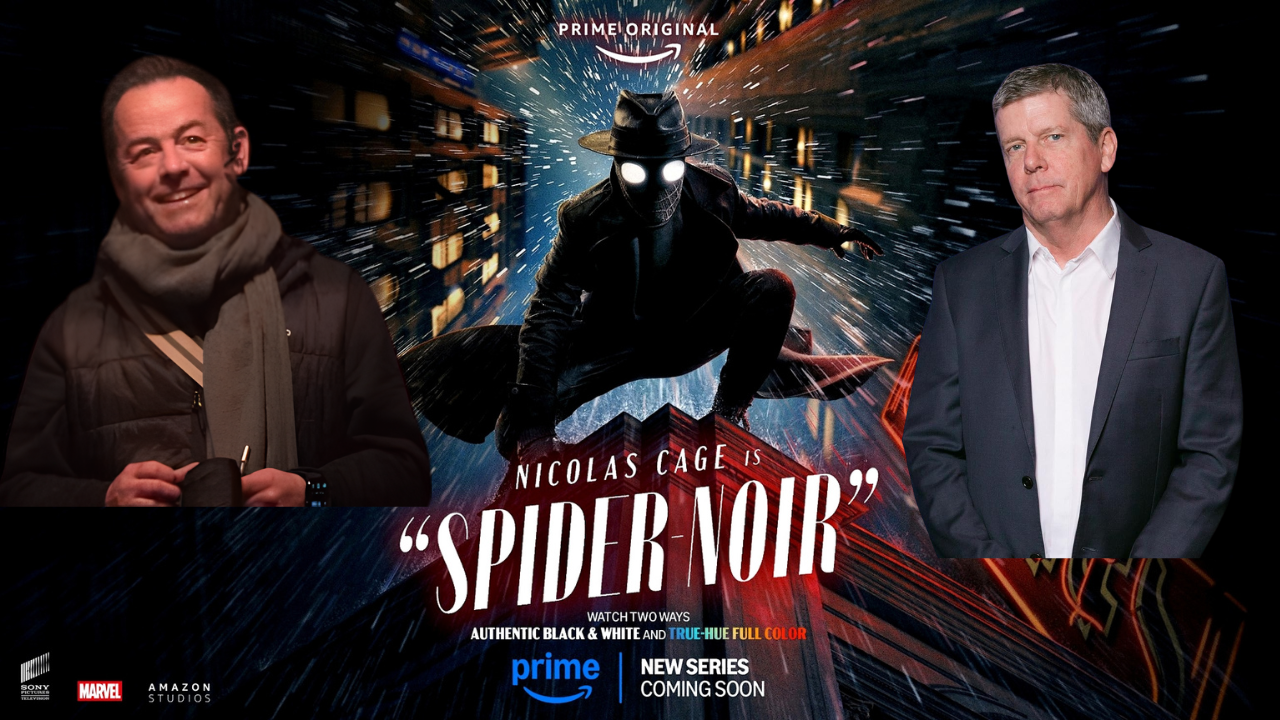
The Cinematography Podcast Episode 360: Darran Tiernan, ISC and Peter Deming, ASC
The live-action Amazon Prime/MGM series Spider Noir starring Nicolas Cage is built around the trenchcoated, black-and-white 1930s New York incarnation of Spider-Man. He was first seen in Spider-Man: Into the Spider-Verse, and is based on a Marvel comic book character. Cinematographers Darren Tiernan, ISC and Peter Deming, ASC were presented with a special creative challenge with Spider Noir. How do you shoot a modern streaming series that looks, feels, and breathes like a classic film noir and make it appeal to contemporary audiences? The answer involved dusting off equipment that hadn’t been used in decades, spending three months building custom LUTs from scratch, and a deep collective immersion in classic film noir movies.
The production faced a decision that would shape every department from day one: the show would be released in both black-and-white and color simultaneously. What followed was three months of intensive testing. Tiernan worked with the show’s colorist to reverse-engineer the look from the inside out. He started not from color and simple switching to black-and-white, as is common, but actually designed it for black-and-white first and then figured out how to build a color version worthy of standing alongside it. They ended up with two distinct black-and-white LUTs, alongside a separate suite of color LUTs.
One of the most striking technical decisions on Spider Noir was the almost complete rejection of LED lighting in favor of dusting off old tungsten units with Fresnel lenses. “I went to my gaffer and said, we’re just going to use old equipment,” Tiernan recalls. “Some of the lights he took out had dust on them. People weren’t really using them. He got a lot of older units that were mainly tungsten. If we needed power, we would use HMIs. And we had a lot of open face lights so we could get deep shadows from them. I rarely ever used LEDs.” Deming, coming in for the later episodes, immediately understood the choice. “The Fresnel lens is something that is unique. There are very few LED units that utilize a Fresnel lens. And of course in the tungsten world, you can start from 200 watts and go up to 20,000 watts with a tungsten lamp. It just doesn’t exist in LED.”
The difference matters most in the context of film noir’s defining visual quality: hard light. “One of the hallmarks of film noir was not only the lighting of faces with harder light, but just creating backgrounds with slashes of light here and there,” Deming says. “And there’s nothing like a Fresnel to do that.” The black-and-white LUT design enhanced the effect, and the team found they could actually move faster on set. “You didn’t have to take light away from the shadows,” Deming explains. “They were already crushed down. So you were really dealing in highlights and midtones and letting the shadows just be created by the light.”
For lensing, Tiernan found a set of Canon Rangefinder still lenses from the 1960s. The choice aligned with one of film noir’s most distinctive compositional habits: deep focus. “We used deep focus constantly. I think it’s appropriate — if there’s six people in a room, we’ll shoot at f/8. With that particular style of lighting, it just sat really well. All of the best-looking noir films play with deep focus in a beautiful way. And I was not afraid of it anymore.”
Deming brought his own tool to the table for the later episodes, particularly for the more hallucinatory sequences. “I own a Lensbaby, which I brought in for a couple of things. That really lent itself to those scenes — being drugged up and all that.” The team also found vintage optical attachments that produced multiple image effects. “It’s sort of B-movie-ish, and we had a lot of fun playing with it,” he says.
Tiernan was immersing himself in specific films throughout the shoot, such as Otto Preminger’s Fallen Angel, Sweet Smell of Success and Night of the Hunter. But the goal was never duplication, but to immerse himself in the atmosphere the films created. Deming articulates the distinction clearly: “I guess what I didn’t want to do was watch a bunch of noir films and start emulating things that other people did. It’s more a vibe, a look that’s in your head, and you create stuff that’s specific to this story instead of recreating touchstones from other films.”
Both DPs also used the “noir vocabulary” of dutch angles, low camera positions, and expressionistic framing. “There would be times we’d ask, how can we make this more noir?” says Tiernan. “But from the very beginning, we were prepared enough that those ideas were already there.” Deming adds: “As we went along in the shooting schedule, those decisions were sort of made before the camera landed — because you would discuss it and say, no, we need to push it more, instead of setting it up and reacting to it. You just reacted to it in discussion and then landed at something more interesting right away.”
Whether you watch Spider Noir in black and white or color, the craft underpinning both versions is the same: a deep and genuine love for what cinema looked like when it was still discovering its own visual style, filtered through two cinematographers who know how to honor that tradition without being trapped by it.
Find Darran Tiernan: Instagram: @dazt
Find Peter Deming: Instagram @peter_deming
Spider Noir is now streaming on MGM Plus and Amazon Prime.
Hear our special Bonus Episode with Peter Deming on his career working with directors Sam Raimi and David Lynch.

CAMERA: Sony VENICE 2
LENSES: Canon Rangefinders, IronGlass Cine Blue Flare, Lensbaby for effects
Close focus: Backrooms has grossed $144 million globally, and Obsession has grossed over $140 million worldwide. Obsession rose 10% from the previous weekend, proving that Gen Z will go to the movies if it interests them.
See the original Backrooms shorts.
Ben’s short end: “Sabotage” by the Beastie Boys was made into a frame-by-frame music video in stop motion by @cordoroyframes on Instagram and YouTube.
Illya’s short end: Hell Grind, an entirely AI film claimed to be at the Cannes Film Festival, but was in fact only playing in a theater in Cannes.
Sponsored by Hot Rod Cameras
Check out the new Betty Luminous Reflector at Hot Rod Cameras! The Betty Luminous is a full-spectrum light reflector designed to beautifully flatter human skin. Its fresnel-like directionality provides focused illumination while its gentle Gaussian falloff ensures a soft, natural look.
Sponsored by Greentree Creative: If you enjoy The Cinematography Podcast and you’re interested in growing or starting your own podcast, contact Alana Kode at Greentree Creative. Greentree Creative can help you with all of your digital marketing needs including podcast launch and creation, advertising, social media management and content creation.
SHOW RUNDOWN:
03:10 Close Focus
14:42-01:06:55 Darran Tiernan interview
01:06:58-01:39:36 Peter Deming interview
01:40:40 Short ends
01:53:43 Wrap up/Credits
LIKE AND FOLLOW US, send fan mail or suggestions! Rate, review and subscribe on Apple Podcasts!
Email: editor@camnoir.com
Facebook:@cinepod
Instagram: @thecinepod
Threads: @thecinepod
Blue Sky: @thecinepod.bsky.social
Podcast Credits:
Producer: Alana Kode
All web and social media content written by Alana Kode
Host and editor in Chief: Illya Friedman
Instagram: @illyafriedman @hotrodcameras
Host: Ben Rock
Blue Sky: @benrock.com
Instagram: @bejamin_rock
Composer: Kays Al-Atrakchi
Check out Kays’ new YouTube Channel, Kays Labs, where he repairs old synthesizers.
Editor: Alana Kode
Subscribe to the Podcast on Apple Podcasts or click on the link below to listen here
Podcast: Play in new window | Download (Duration: 1:11:12 — 0.2KB)
Subscribe: RSS
