
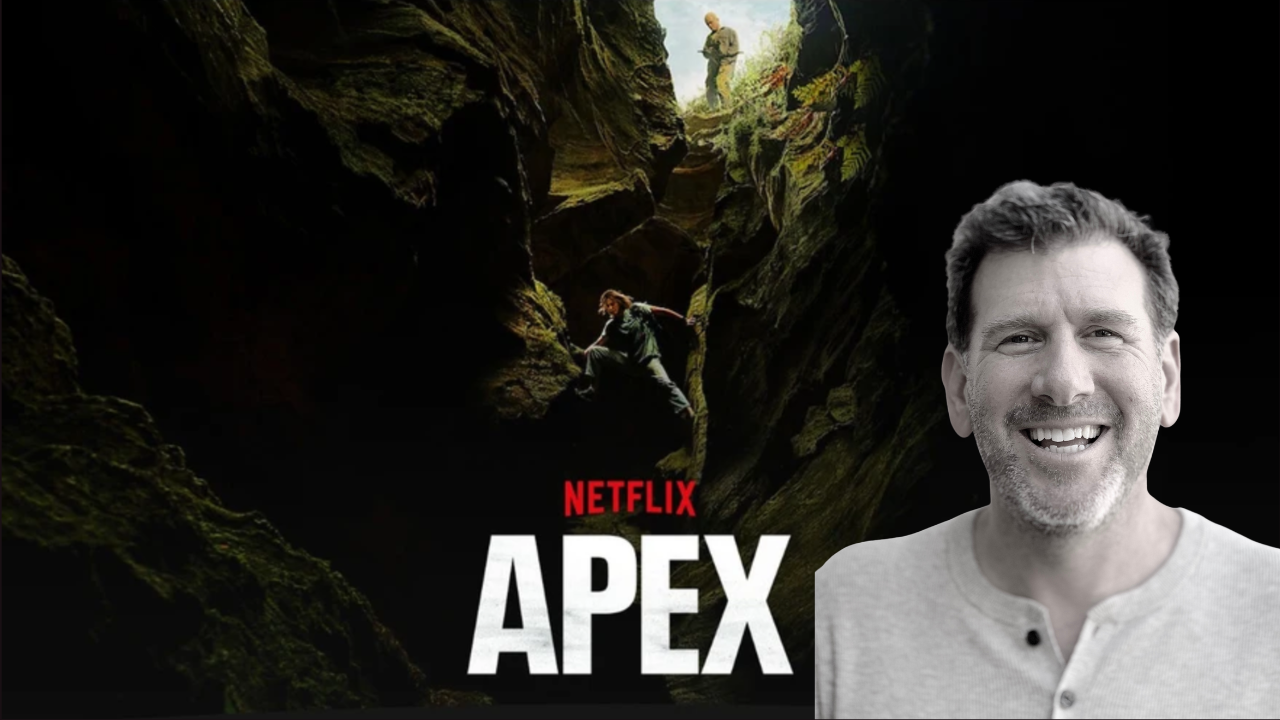
The Cinematography Podcast Episode 357: Lawrence Sher, ASC
When Lawrence Sher, ASC took the job shooting Apex, he knew it was going to be both creatively and physically challenging. “The first time I landed in Australia where we shot the movie, we went on a scout in which I knew I wasn’t in good shape,” Sher admitted. “I’m like, how do I survive this movie, let alone bring cameras into these environments?”
The new Netflix movie is a survival thriller starring Charlize Theron as Sasha, a skilled climber who is hunted by a killer (Taron Egerton) through the Australian mountains. Apex currently sits at number one on Netflix. Director Balthasar Kormákur, whose filmography includes Beast, Everest and 2 Guns, is no stranger to pitting actors against nature. But Apex pushed hard against the boundaries of what conventional filmmaking could achieve. The locations were so remote and so physically demanding to reach, that traditional production equipment simply couldn’t follow. Everything the production needed had to be packed in to each location. “We basically packed Venice bodies into backpacks,” Sher explained. “All our camera assistants and ourselves, we’d all have backpacks with equipment.”
Sher’s solution to the constraints was to form a visual philosophy around them. He borrowed from the world of documentary filmmaking, specifically the kind of breathtaking climbing docs that have redefined how audiences experience vertical landscapes. “Ever since Free Solo, which brought an average person like myself into the climbing world, how could we try to go after something that could feel authentic?” Sher said. “If we were doing this as a documentary, what tools could we use?”
The team built a production toolkit that was lean, modular, and trail-ready. The Sony Venice, a compact workhorse by cinema camera standards, was paired with the Sony Rialto Mini extension system. This allowed the camera body to be separated from its sensor block for tight configurations. For movement, Sher turned to the DJI RS4 gimbal. He chose six or seven lenses, including a lightweight zoom. A collapsible accordion-style arm gave the team occasional crane-style moves without the crane. A drone also became one of the production’s most versatile tools. It could skim just above river surfaces during kayaking sequences, thread through narrow canyon walls, and provide sweeping altitude shots.
For cinematographers, exterior daylight work is always a challenge. “I knew I was going to have to come up with some zen-like philosophy as to what you can’t control,” Sher said. The film effectively takes place in real time across roughly 30 hours, so continuity of light was a constant creative negotiation. He embraced the movement of the sun as part of the film’s texture.
Apex manages to feel simultaneously vast and suffocating, as Theron’s character tries to shake her pursuer. The film’s raw imagery combined with the documentary intimacy of the camerawork let fear build the visual language of the whole film. Sher chose tight focal lengths to compress space, giving the feeling of claustrophobia even in wide-open frames. “Can we make this exciting and visceral,” Sher said, “and try to feel like we are putting ourselves in Charlize’s shoes — and make it thrilling in the most basic definition of that word?”
Find Lawrence Sher: Instagram @lawrencesherdp
See APEX on Netflix
Check out Shotdeck
Hear our previous episodes with Lawrence Sher

CAMERA: Sony Venice II, Mini Rialto
LENSES: Camtec Falcon spherical prime, Canon FD, Laowa zooms, ARRI Signature zooms, DJI drone
Close focus: This year’s Cannes Film Festival has fewer Hollywood stars and movies than in years past.
Ben’s short end: Adobe After Effects has new tools, runs faster and seems easier to use than in previous versions.
Illya’s short end: Paul Trillo, a previous guest on Cinepod, has made a short film using AI with YouTuber Poppy called “The Most Perfect Perfect Person” which explores the relationship between the artist and the real person.
Sponsored by Hot Rod Cameras
Check out the new Betty Luminous Reflector at Hot Rod Cameras! The Betty Luminous is a full-spectrum light reflector designed to beautifully flatter human skin. Its fresnel-like directionality provides focused illumination while its gentle Gaussian falloff ensures a soft, natural look.
Sponsored by Greentree Creative: If you enjoy The Cinematography Podcast and you’re interested in growing or starting your own podcast, contact Alana Kode at Greentree Creative. Greentree Creative can help you with all of your digital marketing needs including podcast launch and creation, advertising, social media management and content creation.
SHOW RUNDOWN:
02:32 Close Focus
13:01-56:48 Lawrence Sher interview
57:13 Short ends
01:07:44 Wrap up/Credits
LIKE AND FOLLOW US, send fan mail or suggestions! Rate, review and subscribe on Apple Podcasts!
Email: editor@camnoir.com
Facebook:@cinepod
Instagram: @thecinepod
Threads: @thecinepod
Blue Sky: @thecinepod.bsky.social
Podcast Credits:
Producer: Alana Kode
All web and social media content written by Alana Kode
Host and editor in Chief: Illya Friedman
Instagram: @illyafriedman @hotrodcameras
Host: Ben Rock
Blue Sky: @benrock.com
Instagram: @bejamin_rock
Composer: Kays Al-Atrakchi
Check out Kays’ new YouTube Channel, Kays Labs, where he repairs old synthesizers.
Editor: Alana Kode
Subscribe to the Podcast on Apple Podcasts or click on the link below to listen here
Podcast: Play in new window | Download (Duration: 1:11:12 — 0.2KB)
Subscribe: RSS
